.avif)

Flooding in Southeast Texas: What to Do in the First 48 Hours
Storm & Flood
Water in your house after heavy rain? What to do first, what not to touch, and why your homeowners policy may not cover it.
Quick answer: Shut off power to affected areas if you can do it safely, photograph everything before you move or throw away a single item, get standing water out and air moving, and call your insurance carrier — but know this first: if the water came in from outside, your standard homeowners policy almost certainly does not cover it. That requires a separate flood policy. Water that came in through a wind-damaged roof usually is covered. Same storm, two different policies, and the deciding factor is where the water came from.
That distinction catches Houston-area homeowners every single time, and it is the reason two neighbors on the same street can have wildly different outcomes from the same rainfall.
Here is the practical order of operations, and the specific mistakes that cost people the most money.
Current conditions — updated Monday, August 31, 2026. The National Hurricane Center's morning outlook gives a northern Gulf disturbance (AL97) a 70% chance of developing before it reaches the Upper Texas or southwestern Louisiana coast. Forecasters expect 4 to 8 inches of rain across Southeast Texas, with isolated totals near 12 inches, arriving Tuesday afternoon or evening and continuing through Wednesday. A Tropical Storm Watch is in effect for coastal Brazoria, Galveston, and Chambers counties. Conditions change quickly — check the National Hurricane Center and your county's emergency management office for the current picture. Everything below applies whether or not this particular system amounts to much.
Hour zero: safety before property
Nothing in your house is worth an electrocution.
Do not walk into standing water in a room where power is still on. If your breaker panel is somewhere you can reach without stepping into water, kill power to the affected circuits. If it is not, leave it and call an electrician or your utility. This is the one step where "I'll just be careful" gets people killed.
Smell for gas. If you smell it, leave and call from outside.
Assume floodwater is contaminated. Water that came in from outside has traveled across streets, yards, and whatever else was between the creek and your door. In the restoration industry this is Category 3 water — the same classification as sewage. Boots, gloves, and no bare skin.
Do not run your HVAC system if water reached the ductwork, the return, or an air handler in a flooded area. Running it pushes contaminated air and spores through every room in the house, including rooms that stayed dry. This turns a two-room problem into a whole-house problem faster than almost anything else you could do.
Hours 1 through 6: document, then act
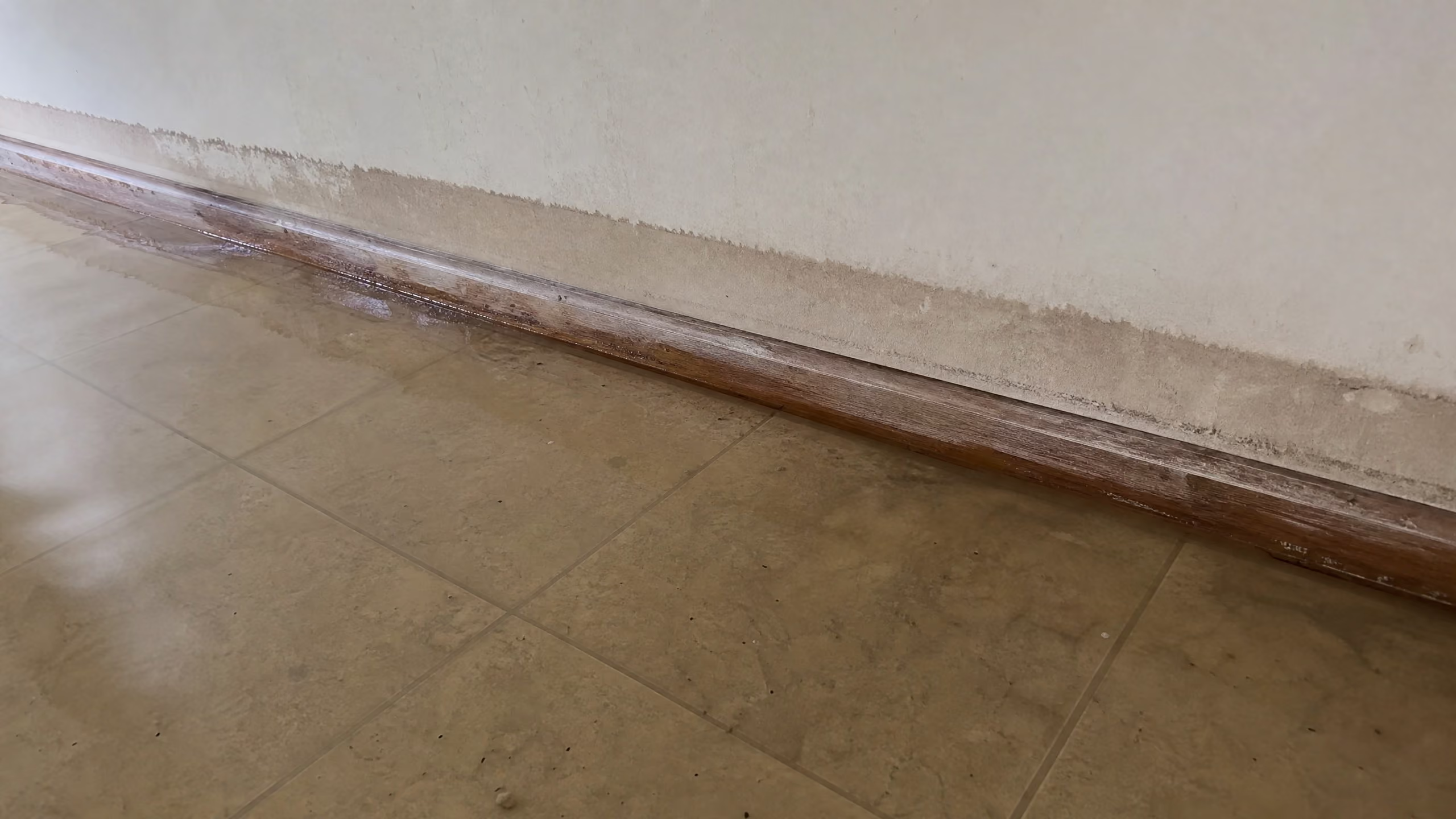
Photograph and video everything before you move it. Wide shots of each room, close-ups of damaged materials, and the water line on the walls. Get the contents too — furniture, electronics, boxes in the garage. Adjusters pay on what you can prove, and the pile at the curb proves nothing.
Then, and only then, start removing water and getting air moving.
What you can do yourself: move undamaged contents to a dry area, pull up loose rugs, get standing water out with a wet vac or pump, and put box fans in doorways pointed at wet areas. One of our customers did exactly that on our advice while waiting for repairs and told us it saved him thousands — because drying started hours earlier than it otherwise would have.
What is worth a phone call: anything where water got behind walls, under cabinets, beneath flooring, or into a wall cavity. Surface water is the part you can see. The part that causes the expensive problem is the part you cannot.
The 24 to 48 hour window is real
Standing water and saturated materials can begin growing mold within 24 to 48 hours in this climate. Southeast Texas humidity means a house does not passively dry out — without mechanical drying, moisture just redistributes into the framing, the subfloor, and the drywall cavities.
That window is why response speed matters more than almost any other factor in what a water loss ends up costing. A house that starts drying in six hours is a very different project from the same house starting in three days.
What gets dried and saved, and what has to come out
This is where flood water differs from a burst supply line, and where homeowners most often make an expensive mistake.
- Material: Carpet and pad; Clean water (broken pipe): Often salvageable with fast extraction and drying; Floodwater from outside: Pad comes out; carpet usually does too
- Material: Drywall; Clean water (broken pipe): Dry in place if caught early; Floodwater from outside: Cut out above the water line
- Material: Insulation; Clean water (broken pipe): May be salvageable; Floodwater from outside: Comes out — it holds contaminated water
- Material: Hardwood; Clean water (broken pipe): Often salvageable with mats and monitoring; Floodwater from outside: Case by case; frequently lost
- Material: Tile on concrete slab; Clean water (broken pipe): Usually fine, dry the substrate; Floodwater from outside: Often fine, but the substrate must be verified dry
- Material: Upholstered furniture; Clean water (broken pipe): Often salvageable; Floodwater from outside: Usually not worth the risk
- Material: Particleboard cabinets; Clean water (broken pipe): Often lost; Floodwater from outside: Lost
Trying to dry and save flood-soaked carpet pad or insulation is the most common well-meant mistake we see. Those materials hold contaminated water against your framing and become the mold source three weeks later, long after everything looks fine.
The insurance part, plainly
Standard homeowners insurance does not cover flood. FEMA states it directly: "Most homeowners and renters insurance do not cover flood damage. Only a flood insurance policy will help you recover after a flood."
What that means in practice, for the same storm:
- Water rising from outside — creek rise, street flooding, surface water coming under the door: this is flood. Covered only by an NFIP or private flood policy.
- Wind-driven rain through a roof breach — shingles gone, water comes through the ceiling: usually covered by homeowners, because the wind damage caused the opening.
- A pipe that burst during the storm — a plumbing failure, not a flood: usually homeowners.
The documentation you take in hour one is what establishes which of these happened. Photograph the roof, the water line, and the direction of entry.
And the hard part: an NFIP flood policy takes effect 30 days after purchase. You cannot buy coverage for a storm that is already on the radar. There are narrow exceptions — a policy bought as part of a mortgage closing, a change made at renewal, and a one-day wait in certain newly-mapped-high-risk and post-wildfire situations — but "I saw the forecast and bought a policy Monday" is not one of them.
If you do not have flood coverage and you are reading this before the water arrives, buying today protects you from the storm 30 days from now, not this one. That is still worth doing. Hurricane season on this coast runs through November 30.
In this part of the metro, the risk is rainfall — not surge
Homes in Spring, The Woodlands, Conroe, Tomball, and Cypress are far enough inland that storm surge is not the threat. The threat is rainfall volume and creek rise — Spring Creek, Cypress Creek, and the tributaries feeding them can come up fast when eight inches falls upstream in a few hours.
That has two practical consequences. First, you can flood on a day when the coast is fine, and the flooding may arrive hours after the rain stops as water works downstream. Second, plenty of homes that flood here are not in a mapped high-risk flood zone — which is exactly the population least likely to carry flood insurance.
When you do not need to call anyone
We would rather tell you this than sell you something you do not need.
If a small area got wet, the water was clean, you extracted it within a few hours, and you have fans and a dehumidifier on it — you may be fine. Watch it for a week. If the drywall stays firm, no smell develops, and the baseboards do not swell or discolor, you likely caught it.
Call someone when: water reached more than one room, it came from outside or from a sewage backup, it has been sitting more than 24 hours, you smell must, or you have any doubt about what is behind the wall. And if you are not sure which situation you are in, that is a perfectly good reason to have someone look before you commit to anything.
Frequently asked questions
Does homeowners insurance cover flooding in Texas?
Generally no. FEMA states that most homeowners and renters policies do not cover flood damage, and only a flood insurance policy covers a flood loss. Water entering through a wind-damaged roof is usually a different matter and typically falls under homeowners coverage, which is why documenting how the water got in matters.
How quickly does mold start growing after a flood?
Mold can begin developing within 24 to 48 hours on wet materials. In Southeast Texas humidity, materials do not dry passively, so mechanical drying started quickly is what prevents a water loss from turning into a mold project.
Can I just dry out my carpet after a flood?
If the water was clean and you extracted it within hours, possibly. If it was floodwater from outside, the pad should come out and the carpet usually should too — those materials hold contaminated water against your framing and become the mold source weeks later.
Should I run my air conditioner after flooding?
Not if water reached the ductwork, the return, or an air handler in a flooded area. Running the system distributes contaminated air and spores into rooms that stayed dry, turning a contained problem into a whole-house one.
Can I buy flood insurance before a storm hits?
Not for that storm. An NFIP policy takes effect 30 days after purchase, with narrow exceptions for mortgage closings, renewal changes, and certain newly-mapped or post-wildfire situations. Buying today protects you from future storms — worth doing, since the season runs through November 30.
What should I photograph before cleanup?
Wide shots of every affected room, close-ups of damaged materials, the water line on the walls, damaged contents, and the point of entry — including the roof if you suspect a breach. Do this before you move or discard anything. Adjusters pay on documented loss.
We answer the phone at 2 a.m.
If water is in your home right now, call Precision Restoration of Texas at (346) 209-2992. Our 24/7 emergency team handles extraction, structural drying, and — when it comes to that — the full rebuild, so you are not managing four contractors during the worst week of your year.
We serve Houston, Spring, The Woodlands, Kingwood, Katy, Cypress, Conroe, Montgomery, Magnolia, Humble, Jersey Village, Pasadena, Porter, and Splendora.
Get Help Now: (346) 209-2992
Explore Storm Damage Recovery, Water Damage Restoration, HVAC & Air Duct Cleaning, and Insurance Claim Assistance for related help from Precision Restoration of Texas.