.avif)

Water Damage Restoration in Katy TX: The One Question That Decides Your Coverage
Water Damage Restoration
In Katy, where the water came from decides whether your policy pays. Reservoir and street flooding versus a burst pipe, and what the first 24 hours require.
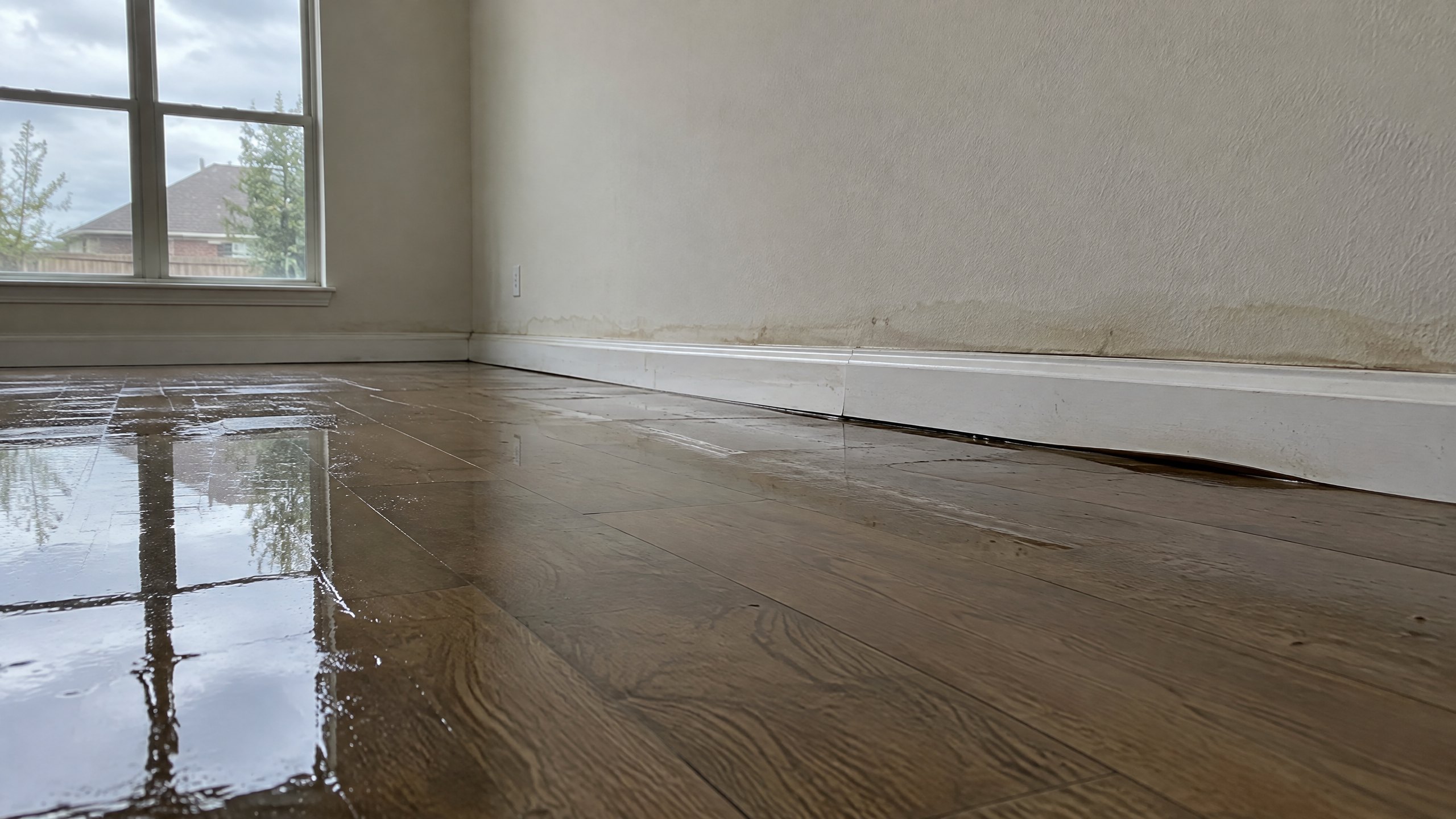
In Katy, the first question that matters is not how bad the damage looks. It is where the water came from. Water that arrives from inside your house, such as a burst supply line, a failed water heater, or an overflowing upstairs shower, is generally covered by a standard Texas homeowners policy. Water that arrives from outside as rising surface water, including street flooding, bayou overflow, and reservoir backwater, is excluded from that same policy and is only covered if you carry separate flood insurance. The damage can look identical on your floor. The claim does not.
That distinction decides your entire financial exposure, and in this part of west Harris and Fort Bend counties it comes up more often than almost anywhere else in the state. Here is what Katy homeowners need to understand before the next event, and what the first day should look like if water is already in the house.
Why Katy Floods Differently Than the Rest of Houston
Katy sits in a genuinely unusual piece of hydrology. Much of the area drains toward Barker Reservoir and the Addicks and Barker system, which are not lakes in the ordinary sense. They are dry detention basins that fill during extreme rainfall and hold water back to protect downtown Houston. When they fill, the pool extends into neighborhoods that are nowhere near a visible body of water, which is how homes several miles from any bayou end up with water in the living room.
The ground works against you too. The clay soils across this area shed water rather than absorbing it, and they swell and shrink with moisture, which is why slab movement and hairline cracking are so common locally. A slab-on-grade foundation with a hairline crack becomes a water path during a prolonged rain event.
Local agencies are actively working the drainage side of this. The Harris County Flood Control District broke ground on March 25, 2026 on the Barker Channel Rehabilitation and Restoration Project, a $10 million, five-year effort to repair erosion, clear sediment and blockages, and restore channel linings upstream of Barker Reservoir. The initial work covers eight sites including Cinco Ranch Greenway Village, Nottingham Country, Green Trails, Mason Creek, Cornerstone Place, and the I-10 and Park Row area. It is real progress. It is also a five-year project, which means the risk profile for the 2026 and 2027 seasons is the one you have now.
The Coverage Split Nobody Explains Until It Is Too Late
Read these two scenarios side by side, because the difference is thousands of dollars.
- Source of water: Burst supply line or pipe; Typical HO policy: Covered; Flood policy needed: No; Notes: Sudden and accidental
- Source of water: Water heater tank failure; Typical HO policy: Covered; Flood policy needed: No; Notes: Tank itself often excluded, resulting damage covered
- Source of water: Upstairs tub or shower overflow; Typical HO policy: Usually covered; Flood policy needed: No; Notes: Category 2 water, sanitation matters
- Source of water: Sewer or drain backup; Typical HO policy: Only with an endorsement; Flood policy needed: No; Notes: Ask your agent, it is cheap to add
- Source of water: Street or yard flooding entering the home; Typical HO policy: Excluded; Flood policy needed: Yes; Notes: Rising surface water
- Source of water: Reservoir pool reaching your home; Typical HO policy: Excluded; Flood policy needed: Yes; Notes: Same category as flood
- Source of water: Roof leak during a storm; Typical HO policy: Covered if the roof was damaged by the storm; Flood policy needed: No; Notes: Long-term leak is a maintenance exclusion
- Source of water: Slow leak under a cabinet over months; Typical HO policy: Usually excluded; Flood policy needed: No; Notes: Gradual damage exclusion
Two practical takeaways. First, if you do not carry flood insurance in Katy because your lender did not require it, you are self-insuring the single most likely large loss in your zip code. Being outside a mapped high-risk zone is not the same as being outside the risk. Second, a sewer backup endorsement is one of the least expensive additions available on a Texas homeowners policy, and it covers a scenario that a lot of Katy homeowners assume is already included.
The First 24 Hours: What Actually Changes the Outcome
Mold does not need a week. Given the right material and temperature, growth can begin within 24 to 48 hours of a material getting wet, and in a Katy summer with the power out and the AC down, the environment is close to ideal.
In order of priority:
Stop the source if it is inside.
Know where your main shut-off is before you need it. If it is a supply line or a water heater, this single action decides whether you have a two-room loss or a whole-floor loss.
Kill power to affected areas
at the breaker if water is near outlets or the panel, and do not walk into standing water in a room with live electrical.
Do not enter floodwater that came from outside.
Street and reservoir water in this area carries sewage, agricultural runoff, and chemical contamination. It is Category 3 water by industry definition and it is a health hazard rather than a cleaning problem.
Document before you touch anything.
Photograph and video every room, every wall at floor level, the source if you can see it, and the water line height on the walls. Do this before removing a single item. Adjusters settle claims from evidence, and yours will be better than anything reconstructed later.
Extract and start air movement.
Bulk water out, then air movers and dehumidification. If you are waiting on a crew and the power is on, box fans aimed at wet walls and baseboards are genuinely better than nothing. One of our neighbors saved themselves thousands doing exactly that on our technician's advice while repairs were scheduled.
Call your carrier and open the claim.
Texas law gives your insurer 15 business days to acknowledge receipt of your claim, and 15 business days after it receives the information it requested to accept or reject it, a deadline the company may extend by 45 days if it explains in writing why it needs more time. Starting the clock early matters.
What not to do: do not pull up wet carpet and throw it out before it is documented, do not run the HVAC if water reached the air handler or ductwork, and do not accept a verbal assurance that something "will dry on its own." Wood, drywall, and insulation dry on schedules that industrial equipment shortens by days.
Why "It Looks Dry" Is Not the Standard
The part of water damage that costs the most is the part you cannot see. Water travels along framing, wicks up drywall by capillary action, and sits under laminate and engineered flooring where nothing evaporates. A wall that feels dry to your hand can read well above dry standard on a meter three feet up.
Proper structural drying means a dry standard established from an unaffected area of the same material in the same building, moisture readings logged daily at the same points, and equipment adjusted as the readings move. The job is finished when the numbers say so, not when the surface looks acceptable. That documentation is also what supports your claim, and it is the difference between an adjuster approving a scope and questioning it.
For homes with slab foundations, which is most of Katy, add one more step: the subfloor and the slab interface have to be verified dry before flooring goes back down. Flooring installed over a damp slab traps moisture and creates the mold complaint you get six weeks later.
When You Do Not Need a Restoration Company
A clean-water spill you caught within a couple of hours, confined to hard surface flooring, with no water under cabinets or into wall cavities, is a mop and a fan. Calling us for that is a waste of your money, and we have told homeowners in Katy and Cinco Ranch exactly that after an inspection found nothing that needed us.
The line is roughly here. If the water touched drywall, insulation, cabinetry, subfloor, or carpet pad, or if it sat more than a few hours, or if it came from anywhere other than a clean supply line, professional extraction and documented drying is the cheaper path. If it did not, keep your deductible.
Frequently Asked Questions About Water Damage Restoration in Katy TX
How fast can you get to Katy from Spring?
We dispatch 24/7 and Katy is inside our standard service area. On emergency calls we prioritize by severity and by whether water is still active, so tell the dispatcher whether the source is stopped.
Does homeowners insurance cover flooding in Katy?
No. Rising surface water, including street flooding and reservoir backwater, requires a separate flood policy. Your homeowners policy covers sudden internal water failures such as a burst pipe or a failed water heater.
How long does the drying process take?
Most residential water losses dry in three to five days with proper equipment. Hardwood, plaster, and multi-layer flooring assemblies take longer. We log moisture readings daily and stop when the material reaches dry standard.
Can I stay in the house during the work?
Usually yes for clean-water losses confined to part of the home. Category 3 contamination, extensive demolition, or loss of a kitchen or only bathroom generally means relocating, and your policy's additional living expenses coverage may reimburse that.
Will you work directly with my adjuster?
Yes. We provide thermal imaging documentation, daily moisture logs, and photo records directly to your carrier, and we work with major carriers regularly. You still choose your own contractor in Texas.
What if mold has already started?
Then the scope changes. Mold work in Texas above 25 contiguous square feet falls under state licensing rules with containment and a third-party clearance requirement. We are TDLR licensed for that work and we will tell you which side of the threshold you are on.
Water in Your Katy Home? Call Before the Drying Clock Runs Out
Every hour that wet material stays wet expands the scope of the repair. If water is in your home in Katy, Cinco Ranch, Nottingham Country, or anywhere along the Barker corridor, we can be onsite, extracting, and documenting for your claim the same day.
We serve Katy, Houston, Spring, The Woodlands, Conroe, Cypress, Kingwood, Humble, Tomball, Magnolia, Montgomery, Porter, Splendora, Sugar Land, Jersey Village, Pasadena, League City, and Galveston.
Call (346) 209-2992">(346) 209-2992 or visit pro-texas.com to schedule an assessment. We are veteran-owned, locally focused, and Aiming for Excellence in every step of the restoration process.
Explore Water Damage Restoration, Storm Damage Recovery, Mold Remediation, and Insurance Claim Assistance for related help from Precision Restoration of Texas.