.avif)

"Black Mold" in a Houston Home: What It Actually Is and What Texas Law Requires
Mold
"Black mold" is not a species, and Texas rules surprise most homeowners. What the 25 sq ft rule means, and why one company cannot test and remediate.
Quick answer: "Black mold" is not a species — it is a color, and dozens of common household molds are dark. The one people mean, Stachybotrys chartarum, cannot be identified by looking at it, and color is not a reliable guide to how hazardous a growth is. What matters far more is how much there is and how wet the material stayed. Texas draws a hard legal line at 25 contiguous square feet: below it, licensing rules generally do not apply and a homeowner can handle it. At or above it, the work must be done by a licensed mold remediation contractor — and by law, that contractor cannot be the same company that tested your home and wrote the plan.
That last rule surprises nearly everyone, including plenty of people in this industry. It is worth understanding, because it is the single best protection Texas gives you against being sold remediation you do not need.
What people mean by "black mold," and why the label misleads
Stachybotrys chartarum is a greenish-black mold that grows on cellulose materials — drywall paper, ceiling tile, cardboard, wood — that have stayed wet for an extended period. It got its reputation in the 1990s and the name stuck.
Two things are true at once. It is a real organism worth taking seriously, and the label "black mold" is close to useless as a diagnostic tool:
- Many common molds are dark. Cladosporium, Alternaria, and Aspergillus species all show up black, dark green, or brown on a wall. You cannot tell them apart by eye, and neither can anyone else.
- Color does not rank hazard. A large area of ordinary Cladosporium behind a shower wall is a bigger problem than a hand-sized patch of anything.
- Only laboratory analysis identifies species — and in Texas, only a licensed mold assessment consultant is authorized to determine the type and extent of what you have.
The practically useful questions are not "is it black?" They are: how many square feet, how long has the material been wet, and where is the water coming from.
The 25 square foot line, and what it means for you
Texas mold rules set a specific threshold. Under §295.303(b) of the Texas Mold Assessment and Remediation Rules, a person is not required to be licensed to perform mold remediation "in an area in which the mold contamination for the project affects a total surface area of less than 25 contiguous square feet."
Twenty-five contiguous square feet is roughly a five-by-five-foot patch. Below that, the licensing regime generally does not apply — which means a homeowner can legally address a small growth themselves.
There is a catch built into the rule, and it is a sensible one. Under §295.303(h), if someone working under that exemption opens up a wall and discovers the contamination is actually larger than 25 square feet, they must stop work immediately and notify the property owner that licensed professionals are now required.
This happens more than you would think. Mold on the visible face of drywall is often the small end of what is inside the cavity. A patch that looks like two square feet in the bathroom can be fifteen behind the tile.
- Situation: Under 25 contiguous sq ft; What Texas rules mean for you: Licensing generally not required — you may handle it
- Situation: At or above 25 contiguous sq ft; What Texas rules mean for you: Licensed mold remediation contractor required
- Situation: Discovered mid-job to exceed 25 sq ft; What Texas rules mean for you: Work must stop; licensed professionals required
- Situation: Any licensed project; What Texas rules mean for you: Independent assessor writes the protocol and performs clearance
The rule that protects you: the company that tests cannot be the company that removes
This is the part most homeowners have never heard, and it matters more than anything else in this article.
Under §295.307(a), "a licensee shall not perform both mold assessment and mold remediation on the same project." The rules go further and prohibit a person from owning an interest in both an assessment entity and a remediation entity working the same project.
Read that again, because of what it implies about how a licensed Texas mold project is supposed to work:
1. A licensed mold assessment consultant — independent of whoever does the removal — inspects, determines the extent, and writes a mold remediation protocol specifying quantities, locations, methods, and clearance criteria. Under §295.312(f)(8) this protocol must be provided to you before remediation begins. 2. A licensed mold remediation contractor performs the work to that protocol. 3. The assessor returns, performs clearance, and issues a passed clearance report. 4. Both parties complete the Certificate of Mold Damage Remediation — Texas Department of Insurance form MDR-1 — after clearance is achieved.
The point of the separation is straightforward: the person who tells you how much mold you have should not be the person who gets paid based on that number.
What this means when you call us. On a licensed project, we are the remediation contractor. We are not permitted to also be your assessor, and we would not want to be — the independence is what makes the clearance report worth anything. If you need an assessment on a project of that size, you need an independent licensed consultant, and we will tell you so.
Be cautious of any company that offers to test your home and remediate it in one package on a licensed-scale project. That is not how the rules are written.
Why the Certificate of Mold Damage Remediation matters later
The MDR-1 certificate is not paperwork for its own sake. It documents that a remediation was performed and passed clearance, and it follows the property.
That matters in two situations most people do not think about until they are in one: selling the house, and insuring it. A property with a documented, cleared remediation is in a materially different position than a property with an undocumented "we cleaned it up." If you are paying for licensed remediation, make sure you end up holding that certificate.
What actually causes mold in Houston homes
Almost nothing on this list is exotic. Mold is a moisture problem wearing a costume.
- Slow supply-line and drain leaks under sinks and behind toilets — the classic, because nobody looks
- Shower and tub surrounds with failed grout or caulk letting water behind tile
- AC condensate line clogs and overflowing drain pans — endemic here, and the pan sits above a ceiling
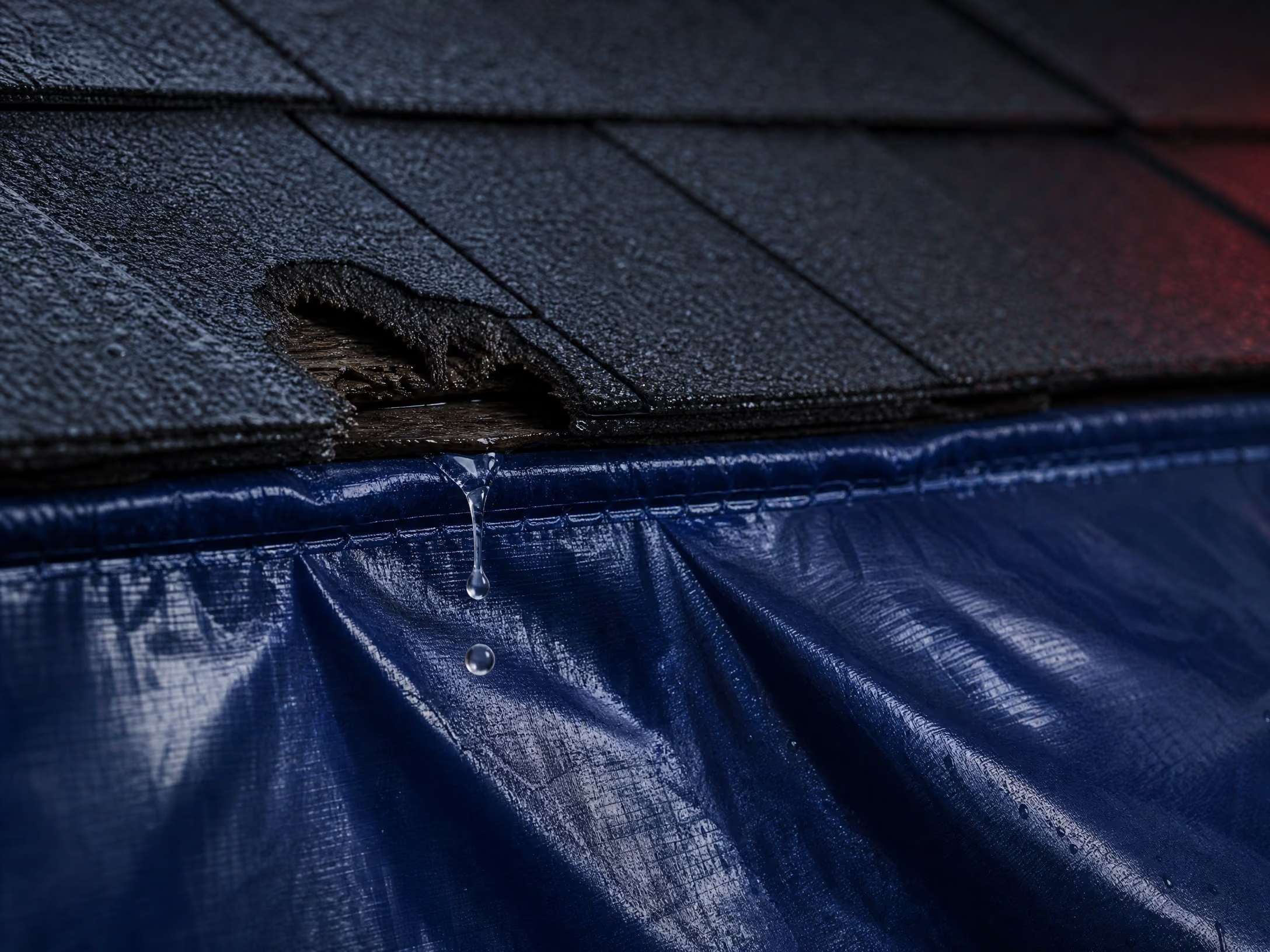
- Roof leaks that wet an attic or wall cavity without ever showing a ceiling stain
- Undried water losses — a burst pipe or flood that was extracted but never properly dried
- Ambient humidity in a closed-up house, especially closets and exterior-wall corners
Notice the through-line. Removing mold without finding and fixing the water source guarantees it comes back, which is why any legitimate remediation starts with locating the moisture. We use thermal imaging and moisture meters to map what is behind the wall before anyone opens anything.
When it is not worth remediating — and when to worry
Probably a cleaning task, not a project: a small patch of surface growth on non-porous material — tile, grout, a tub surround, a painted concrete wall — where you know the water source and have fixed it, and the affected area is well under 25 square feet. Household cleaner, ventilation, dry it out, watch it.
Worth a professional look: growth on drywall, wood, or insulation; anything you cannot see the edges of; a musty smell with no visible source; growth that returns after cleaning; any area at or near the 25-square-foot line; or a growth that appeared after a water loss.
Worth taking seriously right away regardless of size: anyone in the home with asthma, a compromised immune system, or a documented mold allergy, and any growth in or near HVAC ductwork — because the system distributes it everywhere.
To be clear about the health question: we are a restoration contractor, not a medical provider. If you are worried that mold in your home is affecting someone's health, that is a conversation for a physician, and we will not pretend otherwise.
Frequently asked questions
Is black mold more dangerous than other mold?
Not reliably. "Black mold" is a color, not a species, and many common household molds are dark. Stachybotrys chartarum is the one people usually mean, but it cannot be identified by sight. The extent of growth and how long the material stayed wet matter more than color.
Do I need a licensed contractor for mold removal in Texas?
It depends on size. Texas rules exempt projects affecting less than 25 contiguous square feet from licensing requirements. At or above that threshold, a licensed mold remediation contractor is required — and if a smaller job turns out to exceed 25 square feet once opened up, work must stop until licensed professionals take over.
Can the same company test my mold and remove it?
Not on the same licensed project. Texas rules state that a licensee shall not perform both mold assessment and mold remediation on the same project, and prohibit common ownership across both roles on that project. An independent licensed assessment consultant writes the protocol and performs clearance.
What is a Certificate of Mold Damage Remediation?
It is Texas Department of Insurance form MDR-1, completed after a licensed remediation passes clearance. It documents what was done and follows the property, which matters when you sell or insure the home. If you pay for licensed remediation, make sure you receive it.
Can I clean mold myself?
For a small patch of surface growth on non-porous material where you have found and fixed the water source, often yes — Texas rules generally do not require licensing under 25 contiguous square feet. Growth on drywall, wood, or insulation, or anything whose edges you cannot see, is a different situation.
Will mold come back after remediation?
It will if the water source is still there. Mold is a symptom of a moisture problem. Any remediation that does not identify and correct the source — a leak, a condensate line, a roof breach, chronic humidity — is temporary by definition.
Talk to someone who will tell you if you don't have a problem
If you have found something that worries you, call Precision Restoration of Texas at (346) 209-2992. We hold TDLR mold licensing (#70157213) and IICRC certification (#1230909), and we will tell you plainly what we see — including when the honest answer is that you do not need us. That happens more often than you would expect, and we do not charge for the conversation.
We serve Houston, Spring, The Woodlands, Kingwood, Katy, Cypress, Conroe, Montgomery, Magnolia, Humble, Jersey Village, Pasadena, Porter, and Splendora.
Get Help Now: (346) 209-2992
Explore Mold Remediation, Water Damage Restoration, HVAC & Air Duct Cleaning, and Our Certifications for related help from Precision Restoration of Texas.