
How to Find Mold Behind Walls Without Tearing Out Drywall in Houston TX
Mold Remediation
You cannot see behind a wall, but you can measure it. Thermal imaging, moisture meters, and the inspection order that finds mold without guesswork demolition.
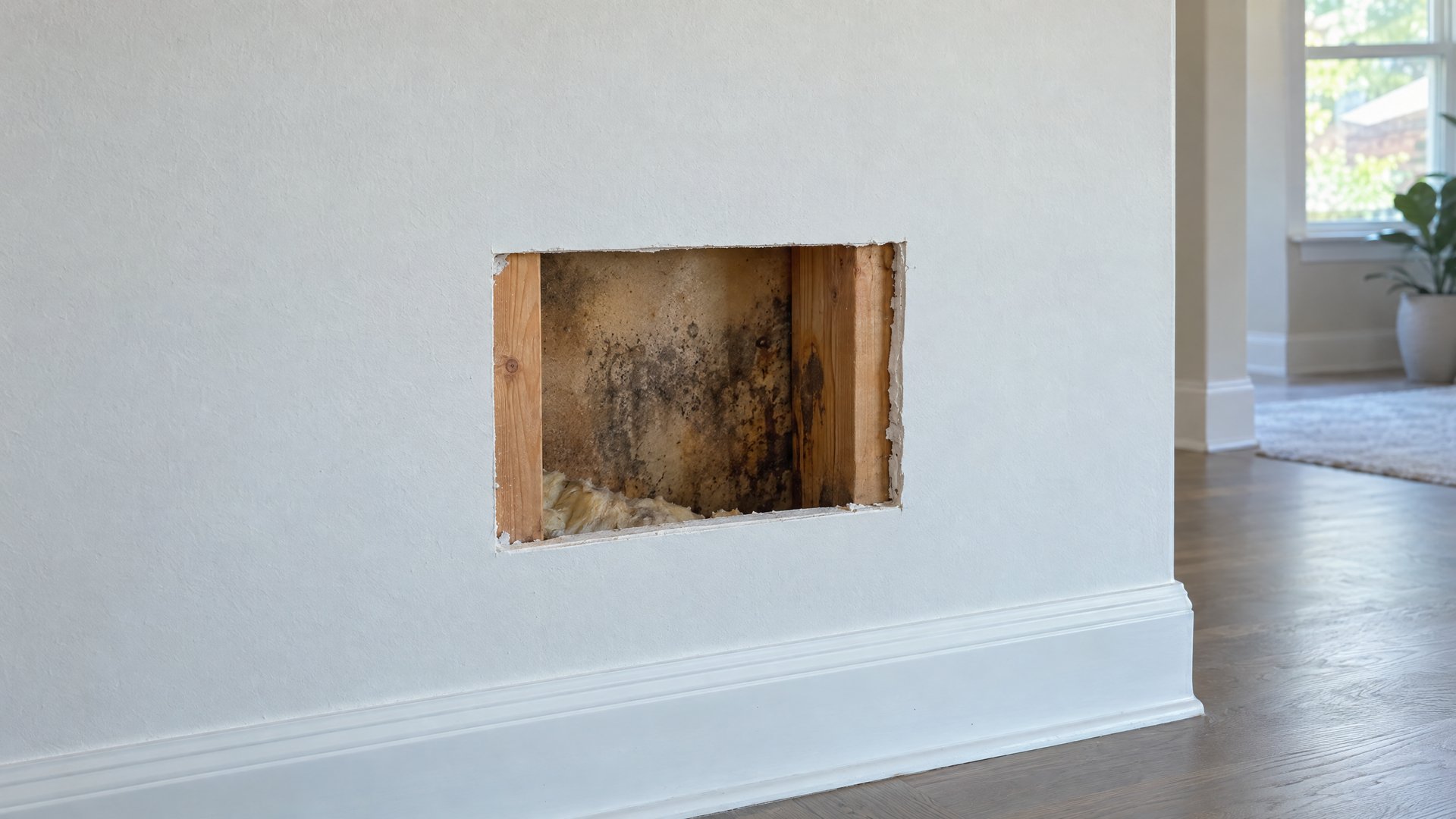
You cannot see through a wall, but you do not have to guess either. Mold behind drywall is found by locating the water that feeds it, and water is measurable without demolition. Thermal imaging shows where an assembly is cooler because it is wet, a moisture meter confirms whether the material is actually wet or just cold, and the two together map the affected area before anyone cuts anything. A single two-inch inspection opening in the right place answers the question. A contractor who opens six feet of wall to start looking has skipped the measurement step.
This matters because the two failure modes are expensive in opposite directions. Guess too cautiously and you leave a growing problem inside the wall. Guess too aggressively and you pay for demolition and rebuild of walls that were fine.
Start With the Smell, Because It Is Data
A persistent musty odor with no visible source is the most reliable indicator of hidden growth, and it is worth taking seriously rather than masking.
Some things that make the smell more informative:
- It is strongest near the source. Walk the room slowly at different heights. Odor from a wall cavity is usually stronger low, near the baseboard, because that is where air exchanges with the cavity.
- It gets worse when the HVAC runs. That points toward the duct system, the air handler, or a cavity the return is pulling air through.
- It is worse after rain. That points to an exterior source: a roof, flashing, a window, or the wall assembly itself.
- It is worse after someone showers or runs a fixture. That points to plumbing, and it narrows the location considerably.
- It comes and goes with humidity. Growth that is not currently wet can still smell when conditions rise.
Write down which of those applies before anyone comes out. It shortens the inspection meaningfully.
The Visible Signs That Point Inward
None of these prove mold. All of them prove water, and water is what you are actually looking for.
- Sign: Bubbling, blistering, or peeling paint; What it usually means: Moisture in the drywall behind the paint film
- Sign: Discoloration or a yellowish stain; What it usually means: Water has wicked through, possibly repeatedly
- Sign: Drywall that is soft when pressed; What it usually means: The gypsum core has been saturated
- Sign: Baseboard separating or warping; What it usually means: Water collected at the base of the wall
- Sign: Flooring cupping or lifting near a wall; What it usually means: Water traveled along the floor from the wall
- Sign: Nail pops or seam cracking in a line; What it usually means: The assembly moved, often from wet framing
- Sign: A cold spot you can feel with your hand; What it usually means: Evaporative cooling from wet material
- Sign: Rusty nail heads or fastener stains; What it usually means: Long-term moisture inside the assembly
That last one is underrated. Fasteners rust from the inside out, and staining around nail or screw heads means moisture has been present for a long time, not a week.
How the Measurement Actually Works
Thermal imaging does not see mold and does not see water. It sees temperature. Wet material is cooler than dry material next to it because evaporation removes heat, so a wet wall cavity shows as a distinct cooler pattern against the surrounding assembly. That pattern is what tells us where to look, and the shape of it is informative on its own. Water running down a stud shows a vertical signature. Water spreading at the bottom plate shows a horizontal band.
Thermal imaging has real limits, and any inspector who does not say so is overselling it. Insulation, sunlight on an exterior wall, a duct run, or a plumbing line all produce temperature differences that have nothing to do with moisture. The image is a map of where to check, not a conclusion.
Moisture meters do the confirming. A pin meter reads the actual moisture content of material through two small probes. A pinless meter reads through the surface without marking it. The number matters only in comparison: the affected wall is measured against unaffected material of the same type in the same building. Drywall that reads well above the same drywall twenty feet away is wet, regardless of how it feels.
Hygrometers measure the air rather than the material, and they matter in Houston. High relative humidity in a closed room, especially one that smells musty, indicates a moisture source that the wall measurements may not fully explain.
The inspection opening is the last step, not the first. When the map says a specific section of wall is wet, a small cut in that section lets us see the cavity, the back of the drywall, the framing, and the insulation. Two inches, in the right place, based on the measurement.
What About Air Sampling?
This is where a lot of money gets spent for little return, so it is worth being direct.
EPA guidance states that in most cases, if visible mold growth is present, sampling is unnecessary, and that because no EPA or other federal limits have been set for mold or mold spores, sampling cannot be used to check a building's compliance with federal mold standards. There is no number that a spore count can be measured against to declare a house safe or unsafe.
What air sampling can legitimately do is compare an indoor sample to an outdoor control, which sometimes helps when you know something is wrong and cannot locate it. What it cannot do is tell you where the water is, and the water is the actionable finding.
There is also a Texas rule worth knowing. On projects that meet the state licensure threshold, the rules prohibit a licensee from conducting both the mold assessment and the mold remediation on the same project. A company offering free testing that leads directly into its own remediation quote on a job that size is describing something the state does not allow.
The Sequence That Avoids Unnecessary Demolition
Interview.
When did the smell start, what makes it worse, what water events has the house had, when was the roof last worked on, any plumbing repairs.
Visual survey.
The signs in the table above, plus the exterior: grading, gutters, flashing, penetrations, irrigation heads aimed at the house.
Thermal scan
of the suspect areas and the walls that share plumbing or roof planes with them.
Moisture confirmation
on every thermal anomaly, with comparison readings from unaffected material.
Humidity reading
of the room and the house.
Targeted inspection opening,
small, in the confirmed wet area.
Measure the affected area,
because that number determines whether this is a Texas licensed project, an EPA-scale DIY job, or nothing at all.
Find the source.
If we cannot tell you where the water came from, we are not finished, because remediation without source correction just resets the clock.
Sometimes the Answer Is That You Do Not Have Mold
This happens on a meaningful share of our inspections and it is a legitimate result. A customer recently called us about a wall they believed had mold. We checked it, found no mold problem, and noticed signs pointing to a roof leak instead, so we told them to call their roofer and did not charge for the visit. Another had us double check walls and vents, and the answer was that there was nothing there.
If someone inspects your home and every visit produces a remediation quote, that is information about the company rather than about your house.
Frequently Asked Questions About Finding Mold Behind Walls
Can thermal imaging see mold?
No. It sees temperature differences, and wet material reads cooler than dry material. It maps where moisture likely is so that a meter can confirm it and an opening can verify it. Any claim that a camera sees mold directly is inaccurate.
Do I need an air quality test to find hidden mold?
Usually not. EPA guidance is that sampling is generally unnecessary when visible growth is present, and there are no federal standards to measure a result against. Moisture mapping locates the problem; sampling does not.
What does mold behind a wall smell like?
Musty, earthy, similar to a damp basement or old paper. It is often strongest near the baseboard, and it commonly intensifies with humidity, after rain, or when the HVAC runs.
How much wall has to come out?
Only the confirmed wet and affected area, which the measurement defines before anyone cuts. On many jobs that is a section rather than a room. Removing more than the map supports is not thoroughness, it is guessing.
Can I find it myself with a hardware store moisture meter?
You can get useful information, especially by comparing a suspect wall to a known dry one. What a consumer meter will not do is see into a cavity or distinguish a wet assembly from a cold one, which is where the thermal scan earns its place.
What if the inspection finds nothing?
Then you have ruled out the walls, and the next candidates are the HVAC system, the attic, the crawl space or slab, or a source outside the room. That is progress, and it is cheaper than demolition.
Musty Smell and No Answer Yet? Let Us Map It
We inspect with thermal imaging and moisture meters before we recommend opening anything, we compare readings to unaffected material so the numbers mean something, and we tell you the measured size of any affected area so you know which rules apply to your project. If the answer is that you do not have a mold problem, that is what you will hear.
We serve Houston, Spring, The Woodlands, Conroe, Katy, Cypress, Kingwood, Humble, Tomball, Magnolia, Montgomery, Porter, Splendora, Sugar Land, Jersey Village, Pasadena, League City, and Galveston.
Call (346) 209-2992 or visit pro-texas.com to schedule an assessment. We are veteran-owned, locally focused, and Aiming for Excellence in every step of the restoration process.
Explore Mold Remediation, Water Damage Restoration, HVAC & Air Duct Cleaning, and Certifications & Licenses for related help from Precision Restoration of Texas.