Upstairs Leak, Downstairs Ceiling: How a Bathroom Leak Becomes a Mold Problem in Houston TX

Water Damage Restoration
A second-floor shower leak shows up as a stain on the ceiling below. What is happening inside that floor assembly, and why the stain is the smallest part.

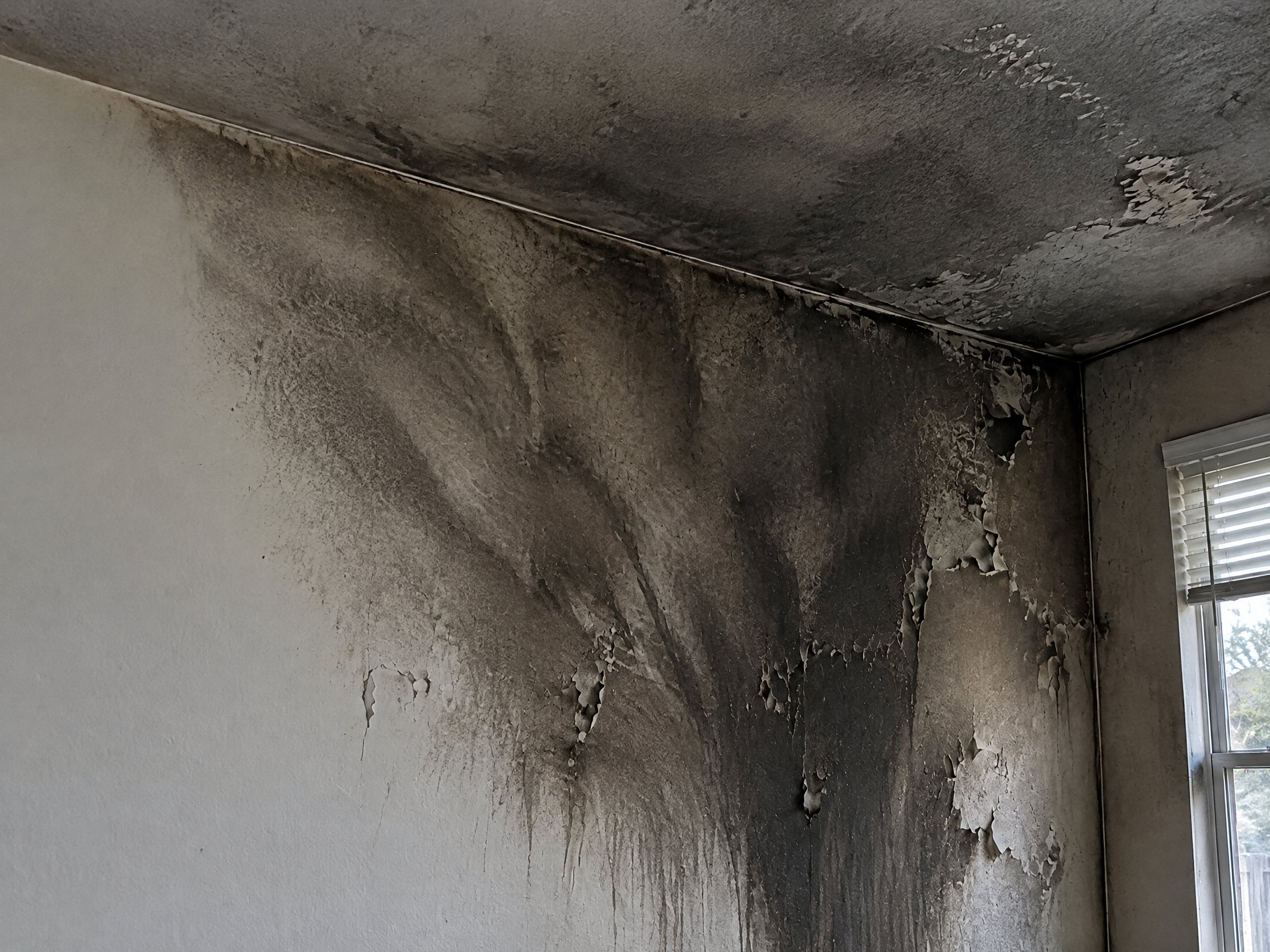
The stain on your downstairs ceiling is the last place the water went, not the first. Between the second-floor bathroom and the ceiling you are looking at sits a floor assembly: subfloor, joists, insulation in some builds, and the paper-faced drywall of the ceiling itself. Water from a shower pan, a supply line, or a wax ring travels along that framing before it finds a seam or a light fixture to come through. By the time it stains the ceiling below, it has usually been wet up there for days, which means the drying window has probably closed and the question is no longer whether there is mold but how far it traveled.
This is the most common job we run in the Houston suburbs, and it is the one homeowners most consistently underestimate. Two recent customers described exactly this sequence to us: an upstairs shower leak that surfaced as damage to the ceiling of the family room below. Here is what is actually happening between those two floors.
Why the Stain Is Always Smaller Than the Damage
Water does not fall straight down through a floor. It hits the subfloor, spreads along the top of it until it finds a gap, then runs along the side of a joist, because framing lumber channels water the way a gutter does. It drops through the ceiling drywall wherever the path happens to end, which can be several feet from the leak and occasionally in a different room.
That is why the visible stain tells you almost nothing about the extent. What it tells you is that water reached the ceiling drywall at that one point. The joist bay above it may be wet for six feet in either direction. The subfloor may be saturated where the leak originates, under a tile floor that looks completely normal from above.
Three things make the cavity a worse place for this than an open room:
- It is enclosed. No air movement, so nothing evaporates.
- It is warm. A ceiling cavity in a Houston home sits between two conditioned spaces and holds heat.
- It is lined with food. Paper-faced drywall, wood framing, and often fiberglass insulation with a paper facing.
The EPA's guidance is that material dried within 24 to 48 hours usually will not grow mold. A ceiling cavity is close to the worst case for meeting that deadline, because nothing about it dries on its own.
The Five Usual Sources, and How to Tell Them Apart
- Source: Shower pan or tile grout failure; Telltale sign: Stain appears or worsens only after someone showers; Urgency: High, water enters with every use
- Source: Toilet wax ring failure; Telltale sign: Stain near the toilet's footprint, may smell foul, water is Category 3; Urgency: High, contaminated water
- Source: Supply line to a sink or toilet; Telltale sign: Continuous, worsens steadily whether or not fixtures are used; Urgency: Emergency, shut off the water
- Source: Tub overflow or drain connection; Telltale sign: Only after a bath, may be intermittent for months; Urgency: Moderate but cumulative
- Source: Caulk failure at the tub or shower surround; Telltale sign: Slow, seasonal, often worst where the surround meets the floor; Urgency: Moderate, cheap to fix, expensive to ignore
The single most useful diagnostic you can run yourself: stop using the upstairs bathroom for two days and watch the ceiling. If the stain stops growing, you have a fixture-use leak such as a shower pan, grout, or overflow. If it keeps spreading, you have a supply line under constant pressure, and that is the one to treat as an emergency.
Why a Toilet Leak Is a Different Job Entirely
If the source is a failed wax ring or the toilet's drain connection, the water is Category 3 under restoration industry classification, which means it carries sewage contamination. That changes the scope in ways that surprise people.
Porous material touched by Category 3 water is removed rather than dried. Affected drywall, insulation, and carpet pad come out. The framing and subfloor get cleaned and treated. You do not get to dry a sewage-contaminated ceiling in place and call it finished, and any contractor who offers to is not following the standard of care.
It also changes whether you should be in the room. A contaminated ceiling cavity above a family room is a health question, not just a property question, and it is worth taking seriously even when the visible damage looks minor.
The Repair Almost Everyone Does Wrong
Here is the sequence that generates the call we get six weeks later. A homeowner finds the stain, has a plumber fix the leak upstairs, then paints over the ceiling stain with a stain-blocking primer. The ceiling looks perfect. Nobody opened the cavity, nobody took a moisture reading, and nobody dried anything.
The plumber did their job. The leak is genuinely fixed. But the water that was already in that floor assembly is still there, in an enclosed warm cavity, and painting over the stain sealed it in. What comes back is a musty smell in the room below, or the stain bleeding through the new paint, or growth discovered years later during a remodel.
The correct sequence:
Fix the source first.
Drying a cavity that is still receiving water is pointless.
Map the moisture.
Thermal imaging from below shows the temperature difference where the assembly is wet, and a meter confirms it. This is how you find out whether you have two feet of wet ceiling or twelve.
Open what needs opening.
Usually a controlled cut in the ceiling drywall to reach the cavity, sized to the mapped area rather than to the stain.
Dry to a measured standard,
with readings logged daily, not until it looks fine.
Address growth if it is there.
If the area meets the Texas 25 contiguous square foot threshold, that triggers licensed remediation with containment and a separate clearance assessment.
Then rebuild.
Drywall, tape, texture match, and paint. Matching a ceiling texture is genuinely difficult, and a bad match is more visible than the original stain was.
What This Costs You If You Wait
There is no honest price to quote here, because the range is enormous and it depends entirely on how far the water traveled. But the cost drivers are predictable, and they all scale with time:
- Area of wet material. Grows every day the source is unfixed.
- Whether mold is present. Remediation adds containment, negative air, licensed labor, and in Texas a third-party clearance on qualifying projects.
- Whether the subfloor is affected. Drying a subfloor from below is possible. Replacing it means taking up the upstairs flooring, which is a much larger job.
- Whether the upstairs flooring is tile. Tile over a wet subfloor usually has to come up, and tile is not salvageable in removal.
- Ceiling texture matching. Older homes with distinctive textures take skilled labor.
- Insurance position. A sudden supply line failure is typically covered. A shower pan that has been leaking slowly for a year is frequently excluded as gradual damage, which is the single largest financial variable in this whole article.
That last point is worth sitting with. The same visible damage can be fully covered or entirely out of pocket depending on how long it took to develop. It is a reason to act on a small stain rather than watch it.
When You Do Not Need Us
If you caught the leak the day it started, the stain is small and fresh, the source is fixed, and a moisture reading of the cavity comes back at dry standard, there is nothing to remediate. Paint the ceiling and move on. We have told homeowners exactly that, including one who called us about a suspected mold problem where we found no mold at all and pointed them toward a roofing issue instead, at no charge.
The honest test is the measurement. If nobody has put a meter in that cavity, neither you nor anyone else knows which situation you are in.
Frequently Asked Questions About Ceiling Damage From an Upstairs Leak
Can I just paint over the water stain?
Only after the cavity is confirmed dry. Painting over a stain on wet material seals moisture into an enclosed space and usually produces a musty odor or a returning stain within weeks.
How do I know if there is mold above the ceiling?
You do not, from below, without either a moisture reading or an inspection opening. Thermal imaging identifies where the assembly is wet, which tells you where to look, and a musty smell in the room is a strong indicator.
Is the whole ceiling going to come down?
Usually not. We cut to the mapped wet area, which is often larger than the stain but far smaller than the room. Full ceiling removal is reserved for extensive saturation or Category 3 contamination.
Will insurance cover a shower pan leak?
It depends on duration. A sudden failure is typically covered. A pan that leaked slowly over months or years is commonly excluded as gradual damage, even though the damage itself looks identical.
How long does this repair take?
Drying is usually three to five days once the source is fixed. Reconstruction of the ceiling, including texture matching and paint, typically adds several days to two weeks depending on the area and the texture.
Should I stop using the upstairs bathroom?
If the stain grows after each use, yes, until the source is identified. If the leak is a pressurized supply line, shut the water off entirely and treat it as an emergency.
Stain Spreading on Your Ceiling? Let Us Map It Before You Cut
The useful first visit is a moisture map, not a demolition plan. We use thermal imaging and meters to define the actual wet area from below, tell you what is behind it, and give you a scope that matches the measurement rather than the stain. If your ceiling is dry and you just need paint, that is what we will tell you.
We serve Houston, Spring, The Woodlands, Conroe, Katy, Cypress, Kingwood, Humble, Tomball, Magnolia, Montgomery, Porter, Splendora, Sugar Land, Jersey Village, Pasadena, League City, and Galveston.
Call (346) 209-2992 or visit pro-texas.com to schedule an assessment. We are veteran-owned, locally focused, and Aiming for Excellence in every step of the restoration process.
Explore Water Damage Restoration, Mold Remediation, Reconstruction & Remodeling, and Insurance Claim Assistance for related help from Precision Restoration of Texas.