.avif)

Who Puts the House Back Together? Mitigation vs Reconstruction in Houston TX
Reconstruction
Most restoration companies dry your house and leave. Here is why mitigation and reconstruction are two estimates, and what that gap costs Houston homeowners.
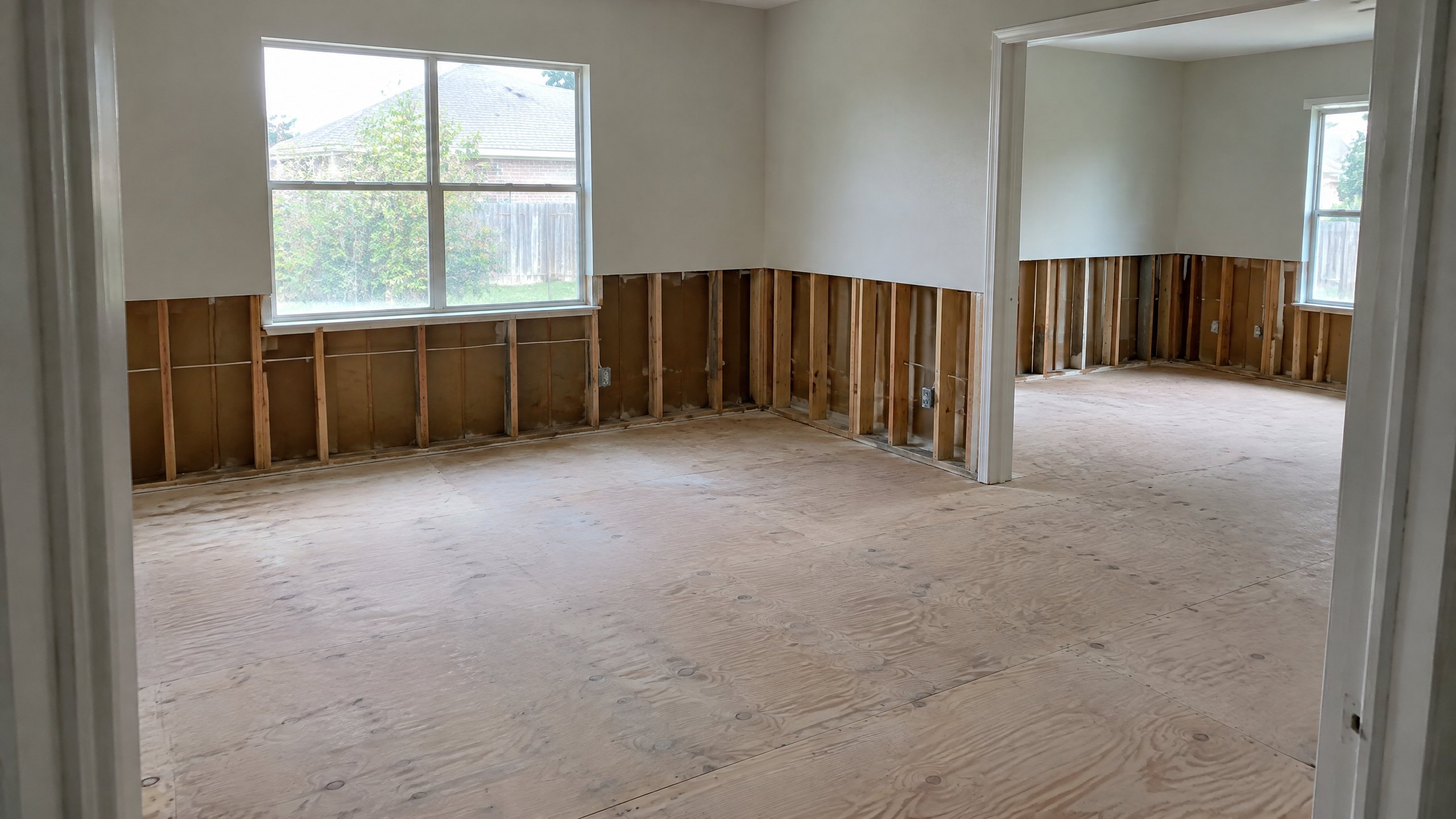
Mitigation and reconstruction are two different jobs, usually two separate insurance estimates, and very often two different companies. Mitigation is the emergency phase: extraction, drying, removal of unsalvageable material. It ends with your house dry, open to the studs, and unlivable in the affected rooms. Reconstruction is everything that makes it a house again: framing repair, drywall, texture, paint, flooring, cabinetry, trim. The gap between them is where Houston homeowners get stranded, because a company that only does mitigation has no contractual obligation to rebuild anything, and many of them do not.
If you take one thing from this article, take this: ask the question before the demolition, not after. "Do you perform the reconstruction, or do I need a separate contractor?" The answer determines whether your project has one point of accountability or two, and whether anyone owns the seam between them.
What Each Phase Actually Includes
- : Goal; Mitigation: Stop the damage from spreading; Reconstruction: Return the property to pre-loss condition
- : Typical work; Mitigation: Extraction, structural drying, dehumidification, controlled demolition, antimicrobial treatment, contents protection; Reconstruction: Framing repair, insulation, drywall and texture, paint, flooring, tile, cabinetry, trim, fixtures
- : Timeline; Mitigation: 3 to 7 days for most residential losses; Reconstruction: 2 weeks to several months, depending on scope and materials
- : How it is estimated; Mitigation: Daily equipment and labor, documented as the work happens; Reconstruction: A scoped, line-item estimate agreed before work starts
- : Insurance treatment; Mitigation: Usually billed separately, often paid first; Reconstruction: Often subject to depreciation held back until work is complete
- : Who is licensed for it; Mitigation: Restoration contractor, IICRC certified; Reconstruction: General contractor, plus trade licensing where required
- : What it leaves you; Mitigation: A dry, open, structurally sound but unfinished space; Reconstruction: A finished, livable home
The insurance mechanics deserve a second look. Most policies pay reconstruction on an actual cash value basis first, holding back depreciation, and release the remaining recoverable depreciation after the work is completed and documented. That means the rebuild money arrives in two pieces, and the second piece only arrives if someone finishes the work and submits proof. A homeowner who never engages a reconstruction contractor frequently leaves that second payment unclaimed.
The Gap, and What It Costs
Here is the sequence that goes wrong. A water loss happens on a Tuesday. A mitigation crew arrives, extracts, sets equipment, and over the next four days removes wet drywall to two feet, pulls the flooring, and takes out the vanity and the lower cabinets. On Friday the equipment comes out, the crew shakes your hand, and you are standing in a bathroom with exposed studs and a subfloor.
Now you start calling general contractors. It is week two. Every GC wants to see the adjuster's scope, and half of them do not work with insurance claims. The good ones are booked six weeks out. Your bathroom stays open. Meanwhile the adjuster's estimate was written in a software line-item format that the GC prices differently, and the difference becomes a negotiation you are now running yourself.
The costs of that gap are real and rarely counted:
- Time. The single largest driver of total project length in restoration claims is the handoff, not the work.
- Money. A second mobilization, a second set of overhead, and a scope written by one company and executed by another usually means at least one supplement request.
- Accountability. When the finished floor buckles four months later, the mitigation company says the rebuild crew installed over a damp slab, and the rebuild crew says the mitigation was never completed to dry standard. You are the one holding both invoices.
- Coverage. Additional living expenses coverage pays while you are displaced, but policies have limits and time caps. Weeks lost between contractors burn that allowance.
What a Single-Contractor Project Changes
When one licensed company performs both phases, the seam disappears. The moisture readings that closed the mitigation phase are the same records that authorize flooring installation. The person who removed the cabinetry is accountable for what replaces it. The adjuster works one scope, one supplement process, one set of documentation.
That is the model we run. Precision Restoration of Texas performs emergency mitigation and structural drying, and our general contracting team handles the reconstruction: framing and joist repair, drywall and texture matching, flooring and tile, painting, and full interior and exterior structural repairs. Our clients sign once and get one project manager who is answering for both halves. Several of the reviews we are proudest of describe exactly this, the project manager who kept answering texts on a Sunday through a rebuild.
The practical benefit is not just convenience. It is that no one can blame the other guy.
When One-Stop Is the Wrong Choice
We would rather be honest about this than pretend there is no downside.
A single restoration contractor is not automatically the right call when the rebuild is a large custom or architectural project. If your loss destroyed a custom kitchen with millwork by a specific cabinetmaker, or your home has historically accurate detail, or you were planning a significant remodel anyway and the claim is now an opportunity to do it, you may be better served by a dedicated custom builder for the reconstruction phase, with the mitigation handled separately.
The same is true if you already have a general contractor you trust and have used for years. That relationship has value, and no restoration company should ask you to abandon it. What matters in that case is that the mitigation company hands over complete drying documentation, and that your GC confirms dry standard before covering anything up.
One more point of Texas consumer protection: the choice is yours. Your insurer may recommend a preferred vendor from its network, and it may have real advantages, but you select the contractor who performs the work on your home. A recommendation is not an assignment.
Working the Claim While the Work Happens
Texas puts deadlines on your insurer that are worth knowing. Your company has 15 business days to tell you it received your claim, and 15 business days after it gets what it asked from you to decide whether it will pay. It can extend that decision deadline by 45 days if it tells you in writing why it needs the time. If it rejects the claim, it must state the reason in writing.
What speeds all of this up is documentation quality, and mitigation is where documentation is created or lost. Thermal imaging of the moisture footprint before demolition, daily moisture logs at consistent points, photographs of every affected material before it is removed, and a written dry-standard certification at the end. That package is what makes a reconstruction scope defensible instead of debatable.
Frequently Asked Questions About Mitigation and Reconstruction in Houston
Can I use different companies for mitigation and rebuild?
Yes, and sometimes you should. Just make sure you receive the complete drying documentation from the mitigation company, and that your rebuild contractor verifies dry standard before closing walls or installing flooring.
Does my insurance pay both separately?
Usually. Mitigation is typically billed as its own invoice based on documented equipment and labor, and reconstruction is a scoped estimate. Reconstruction is commonly paid in two parts, with recoverable depreciation released after completion.
How long does reconstruction take after drying?
Two to six weeks covers most single-room and single-floor losses. Kitchens, custom cabinetry, specialty flooring, and anything requiring permits or engineering run longer. Material lead times are usually the constraint, not labor.
Do I have to use the contractor my insurance recommends?
No. In Texas you choose the contractor who works on your property. Your carrier may recommend a network vendor, but that recommendation does not obligate you.
What if the adjuster's estimate is lower than my contractor's?
That is a supplement, and it is routine. Your contractor documents the difference with photos, measurements, and line items, and submits it to the adjuster. Most disputes resolve at this stage without escalation.
What should I get in writing before demolition starts?
The scope of the mitigation, whether the company performs reconstruction, who your project manager is, and confirmation that you will receive drying documentation and, on mold projects, a Certificate of Mold Damage Remediation.
One Contractor, Start to Finish, Across the Houston Area
If your home is dry, open, and you are trying to figure out who rebuilds it, or if you are still at the front of a loss and want to avoid the handoff entirely, we can scope both phases in one visit and one estimate.
We serve Houston, Spring, The Woodlands, Conroe, Katy, Cypress, Kingwood, Humble, Tomball, Magnolia, Montgomery, Porter, Splendora, Sugar Land, Jersey Village, Pasadena, League City, and Galveston.
Call (346) 209-2992">(346) 209-2992 or visit pro-texas.com to schedule an assessment. We are veteran-owned, locally focused, and Aiming for Excellence in every step of the restoration process.
Explore Reconstruction & Remodeling, Water Damage Restoration, Insurance Claim Assistance, and Financing Options for related help from Precision Restoration of Texas.