How Long Before Mold Grows After Water Damage? The Houston Answer

Water Damage Restoration
The EPA says material dried within 24 to 48 hours usually will not grow mold. Here is what that means in Houston humidity, and when you are past the window.
The working number is 24 to 48 hours, and the EPA states it as good news rather than a threat: "If wet or damp materials or areas are dried 24-48 hours after a leak or spill happens, in most cases mold will not grow." That is the whole game. Mold is not inevitable after water damage. It is what happens when material stays wet past that window. In a Houston August, with indoor humidity high and the air conditioning possibly down, you are working the fast end of that range. In a dry, conditioned house in January, you have more room. Either way, the clock starts when the material gets wet, not when you notice it.
That framing matters, because the restoration industry has spent twenty years using the 48 hour number to sell fear. The accurate version is more useful: act inside the window and you likely have a drying project. Miss it and you have a remediation project, which is a different scope, a different license requirement in Texas, and a different insurance conversation.
Why 24 to 48 Hours, and What Actually Moves the Number
Mold needs three things: spores, which are present in every building on earth, organic material to eat, and water. The EPA is blunt about the third: "There are many types of mold, and none of them will grow without water or moisture." You cannot remove spores from a house and you would not want to. Water is the only variable you control.
The 24 to 48 hour range is not a countdown timer. It moves with conditions:
Faster than 48 hours:
- Warm temperatures, which describes Houston from roughly April through October
- High indoor humidity, especially with the AC off after a power outage or because the system itself was affected
- Highly absorbent material: paper-faced drywall, carpet pad, fiberglass insulation, MDF cabinetry, and the paper backing on wood flooring
- Water that was already dirty. Category 2 and 3 water carries its own organic load
- Still air in an enclosed cavity, which is exactly what a wall is
Slower:
- Cooler, drier conditions
- Non-porous surfaces like sealed concrete, tile, and metal
- Water that was extracted quickly and followed by real air movement
The place this bites Houston homeowners is the cavity. A wall or a ceiling assembly is a warm, dark, still, humid box lined with paper-faced gypsum. If water gets in there and nothing forces air through it, the surface of your wall can look and feel dry while the back of that same drywall stays wet for a week or more.
The Question Behind the Question: When Did the Water Start?
Most people asking how fast mold grows have already found water. The honest answer depends on a fact they usually do not have, which is how long it has been there.
- What you found: Active leak you just heard or saw; Likely age: Hours; What it means: You are inside the window. Drying project.
- What you found: Wet carpet, no odor, no staining; Likely age: Under 48 hours; What it means: Probably inside the window if you act today
- What you found: Water stain on a ceiling, edges dry and ringed; Likely age: Days to weeks; What it means: Past the window. Assume growth in the cavity.
- What you found: Musty smell with no visible water; Likely age: Weeks or longer; What it means: The moisture source is still active somewhere
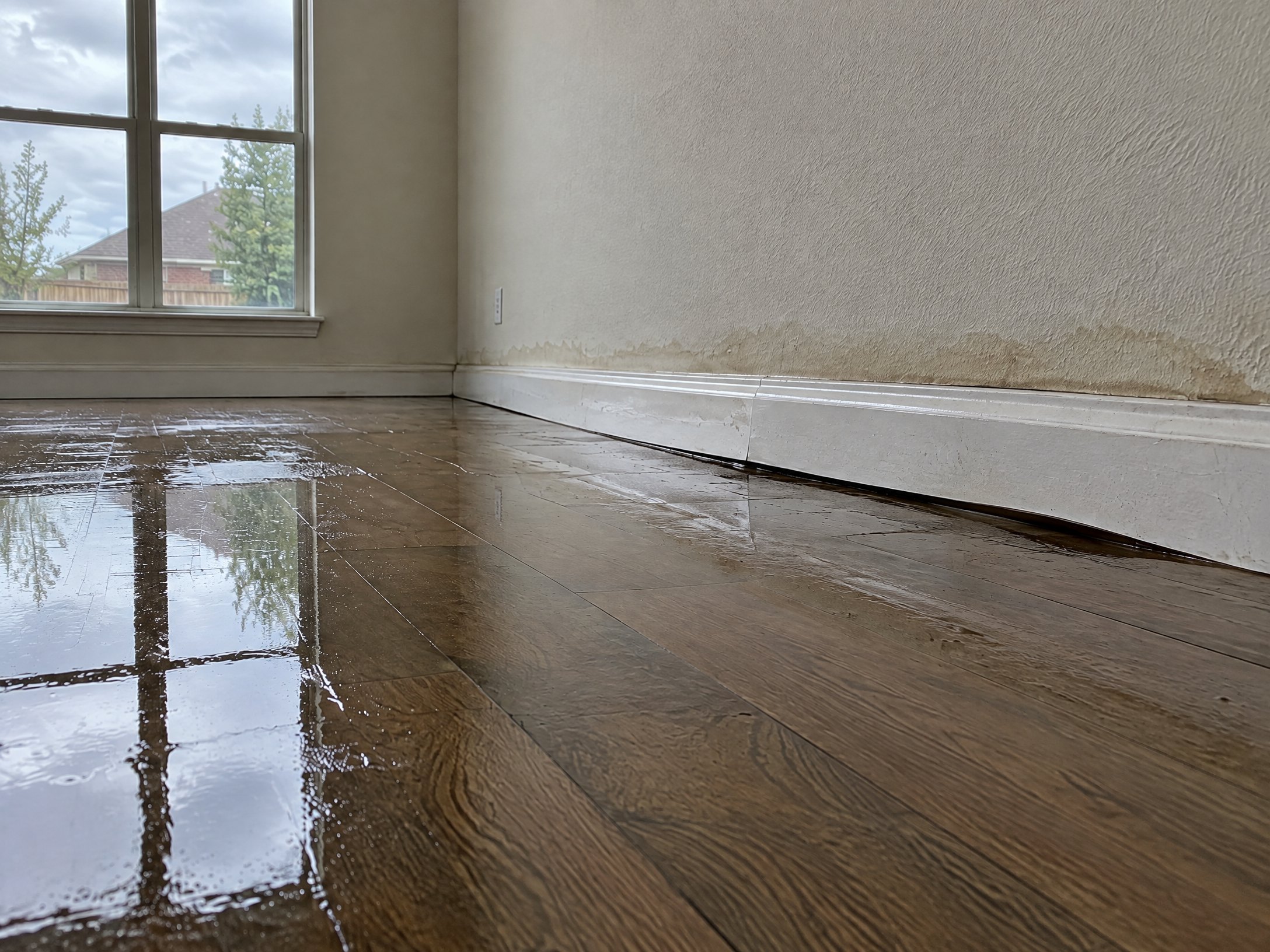
- What you found: Buckled flooring or soft baseboard; Likely age: Weeks; What it means: Material has been saturated long enough to deform
- What you found: Visible growth; Likely age: Past the window by definition; What it means: Remediation scope, not a drying scope
A dark ring around a stain is the tell that matters. Water that soaks and dries repeatedly leaves concentric edges, and that means this has happened more than once. A single event leaves a more uniform mark.
What to Do in the First 24 Hours
The actions that actually change the outcome, in order:
Stop the water.
If it is a supply line, a water heater, or a fixture, shut it off at the source or at the main. Everything else is secondary to this.
Get bulk water out.
A wet vacuum on hard surfaces and carpet. Standing water is what keeps feeding the material.
Move air, aggressively.
This is the step homeowners skip and it is the one that makes the deadline achievable. Fans aimed at wet walls, baseboards, and flooring, running continuously. One of our neighbors was told exactly this by our technician during an assessment, bought box fans, ran them at the affected areas, and the material was dry when we reassessed three days later. No remediation, no claim.
Lower the humidity.
Run the air conditioning if the system is unaffected, or a dehumidifier. Pushing wet air around a closed humid house just moves the water somewhere else.
Open the cavity if water got behind it.
Removing baseboard and drilling or cutting weep holes lets air reach the back of the drywall. This is a judgment call and it is worth a professional opinion before you start cutting.
Document everything.
Photos before you move anything, and keep them even if you handle the whole thing yourself. If mold shows up in six weeks, that record is what connects it to a specific covered event.
What does not work: a closed room with a fan blowing on the carpet, a bowl of baking soda, or waiting to see whether it dries on its own. And bleach is not a preventative. The EPA states that using a biocide such as chlorine bleach "is not recommended as a routine practice during mold cleanup," and spraying a water-based product onto material you are trying to dry works against you.
When You Are Past the Window
If the water has been there for a week, mold is a reasonable assumption rather than a worry, and the useful question becomes how much and where. That is a measurement, and it determines everything that follows.
Two numbers get confused constantly, and they are not the same thing:
- The EPA's 10 square feet is a practical DIY guideline. EPA guidance says that if the moldy area is less than about 10 square feet, roughly a 3 foot by 3 foot patch, in most cases you can handle it yourself.
- Texas's 25 contiguous square feet is a legal licensure threshold. At or above it, the work falls under state mold rules requiring a licensed remediation contractor, a written protocol, containment, and a clearance assessment by a separate licensed party.
So there is a middle band, roughly 10 to 25 square feet, where Texas does not require a licensed contractor but the EPA's own guidance suggests you probably want one. That gap is where homeowners make the most expensive decisions with the least information.
The Part Most Restoration Companies Will Not Tell You
Not every water loss becomes a mold job, and a company that quotes remediation on a loss it dried properly within the window is selling you something you do not need.
If your material was dried to standard inside 48 hours, documented with moisture readings rather than a technician's opinion, there is usually no mold work to do. Ask for the readings. A legitimate drying project ends with numbers showing the affected material back at the same moisture content as unaffected material of the same type in the same building. That document is your proof, and it is worth more than a verbal all clear.
The inverse is also true, and it is the more common failure. A loss that was "dried" with two fans over a weekend, with no readings taken and no cavity opened, frequently produces a mold complaint six weeks later. At that point the connection to the original covered event is harder to establish, which affects the claim.
Frequently Asked Questions About Mold After Water Damage
Can mold really grow in 24 hours?
Under the right conditions, growth can begin that fast, which is why the EPA frames the guidance as drying within 24 to 48 hours. Warm temperatures, high humidity, and absorbent material like paper-faced drywall push it toward the fast end.
My carpet got wet and dried on its own. Do I have mold?
Probably not if it dried within a day or two and there is no odor. The risk is the pad underneath and the subfloor, which hold water much longer than the carpet face does. A moisture reading answers this in about five minutes.
Does a water stain on the ceiling always mean mold?
No. It means water was there. Whether mold followed depends on how long the material stayed wet and whether the leak is still active. A stain with dark concentric rings suggests repeated wetting, which raises the odds considerably.
Will running the air conditioning help dry things out?
Usually yes, because an AC system dehumidifies while it cools. The exception is when water reached the air handler, the return, or the ductwork. In that case running it can distribute moisture and spores through the house.
How do I know when it is actually dry?
By measurement, not by touch. A moisture meter compares the affected material to unaffected material of the same type in the same building. Surfaces feel dry long before the material behind them is.
If I dry it fast, do I still need to tell my insurance company?
It is generally worth reporting a water event even if you handle the drying, because it establishes the date and cause. Mold discovered later is much easier to connect to a covered loss when the original event is already on record.
Water in Your Home Right Now? The Window Is Open
If the water started today, you are almost certainly still inside the 24 to 48 hour window, and same-day extraction and air movement is what keeps this a drying project instead of a remediation project. We dispatch around the clock, we document moisture readings daily, and if we assess your home and find nothing that needs us, we will tell you that. Several of our neighbors in Spring and The Woodlands have heard exactly that.
We serve Houston, Spring, The Woodlands, Conroe, Katy, Cypress, Kingwood, Humble, Tomball, Magnolia, Montgomery, Porter, Splendora, Sugar Land, Jersey Village, Pasadena, League City, and Galveston.
Call (346) 209-2992 or visit pro-texas.com to schedule an assessment. We are veteran-owned, locally focused, and Aiming for Excellence in every step of the restoration process.
Explore Water Damage Restoration, Mold Remediation, Reconstruction & Remodeling, and Insurance Claim Assistance for related help from Precision Restoration of Texas.