.avif)

Mold in AC Vents in Houston TX: Why Cleaning the Ducts Often Does Not Fix It
Mold Remediation
Mold in Houston AC vents is a moisture problem, not a dust problem. What the EPA says about moldy insulated ducts, and when duct cleaning is the wrong call.
Mold in an AC vent is almost always a moisture problem, not a dirt problem. The growth you can see at the register is usually the end of the trail, and the water feeding it sits upstream at the evaporator coil, the condensate drain, or inside the duct insulation itself. That matters for a specific reason: the EPA states that if insulated air duct components get wet or moldy, the insulation "cannot be effectively cleaned and should be removed or replaced." Most Houston-area homes are ducted with insulated flex duct. Cleaning it is not the fix. Replacing the affected runs, and correcting the moisture source, is.
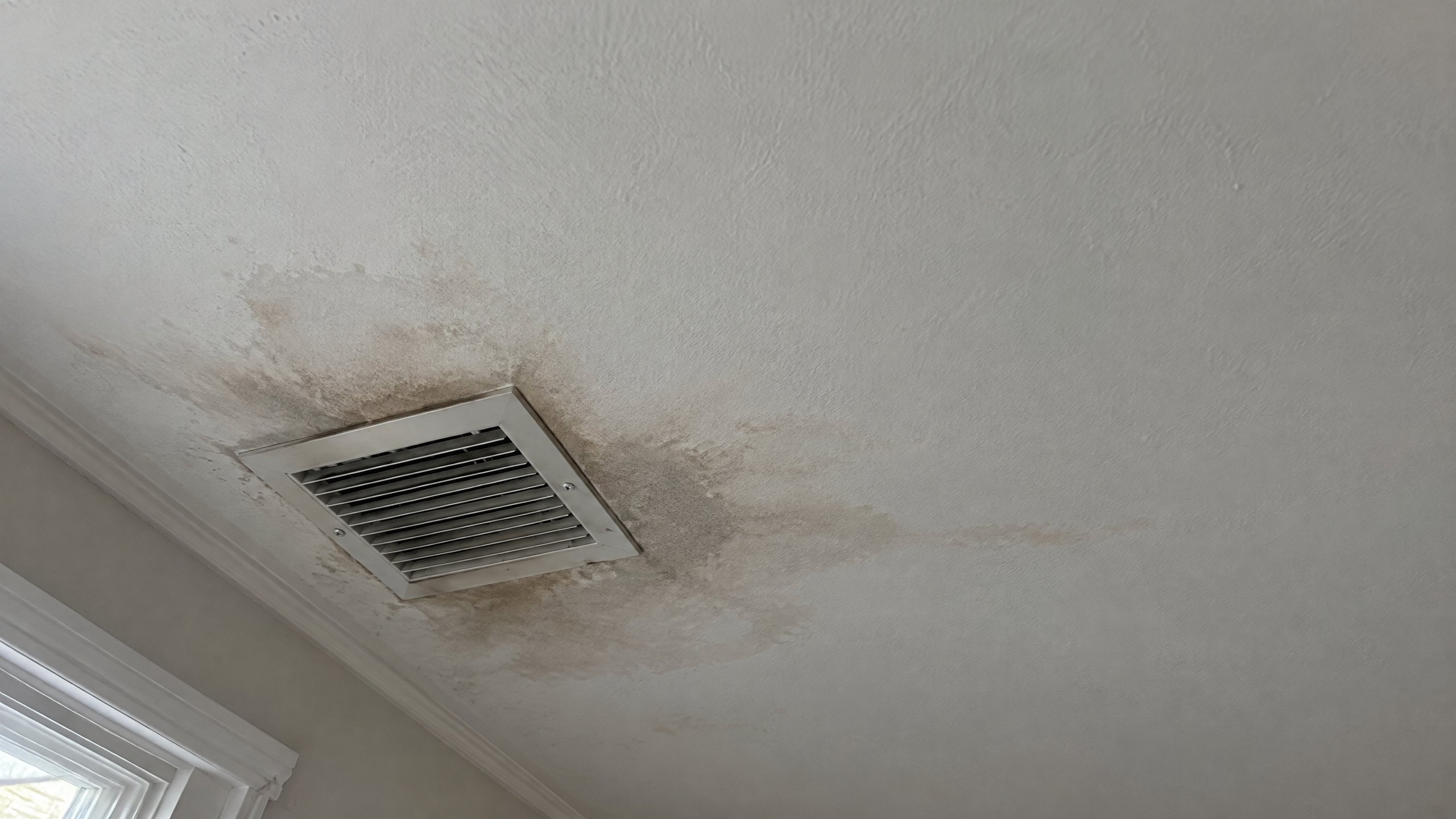
If you found dark spotting around a supply register in Spring, Cypress, or The Woodlands, you are not looking at an unusual problem. You are looking at the predictable result of a cooling system that runs nine months a year in a climate that keeps outdoor dew points high most of the summer. Here is how to tell what you actually have, and what a legitimate repair looks like.
Why Houston AC Systems Grow Mold in the First Place
An air conditioner is a dehumidifier that happens to cool. Every cooling cycle pulls moisture out of your indoor air and condenses it on the evaporator coil, where it drips into a pan and out through a condensate line. That is normal and healthy. Mold begins when any part of that system stops shedding water the way it was designed to.
Four failures cause most of what we find in the Houston area:
- A clogged condensate drain. The pan backs up, the water finds the platform or the return plenum, and the insulation under it stays damp between cycles.
- An oversized system. A unit too large for the house satisfies the thermostat fast and shuts off before it has run long enough to strip humidity. The house feels cold and clammy. Interior surfaces and duct interiors stay wet.
- Duct leakage in a hot attic. Conditioned air escaping a loose connection creates a cold surface surrounded by attic air at 120 degrees and high humidity. Condensation forms on the outside of the duct, wicks into the insulation, and grows inward.
- Unfixed water damage nearby. A roof leak or a supply line break above a duct run leaves that insulation wet for days. The visible drywall dries. The insulation does not.
Notice what every one of those has in common. None of them is caused by dirty ducts, and none of them is solved by cleaning ducts.
Is It Actually Mold? Do Not Assume
This is worth slowing down on, because guessing costs money in both directions. The EPA is explicit: "although a substance may look like mold, a positive determination of whether it is mold or not can be made only by an expert and may require laboratory analysis for final confirmation."
Black staining around a register is frequently something else entirely. Common look-alikes include soot from candles or a fireplace, dust bonded to a vent by condensation, and ordinary filter bypass, which is the dark outline you get when air sneaks around a loose filter and deposits fine particulate on the register face. If the discoloration wipes off cleanly and does not come back, you probably had a housekeeping issue. If it returns in the same pattern within weeks, water is involved.
A musty smell that intensifies when the system kicks on is a stronger signal than anything you can see. Growth inside a duct or on a coil sits directly in the airstream, so the odor arrives with the air.
The Expensive Surprise: Insulated Flex Duct Cannot Be Cleaned
Most residential duct systems built in this region in the last thirty years are flexible duct: an inner liner, a wrap of fiberglass insulation, and an outer vapor jacket. When the insulation in that assembly gets wet and grows mold, there is no cleaning process that restores it. The EPA's guidance is direct on this point, and the reason is physical rather than procedural. You cannot scrub the inside of a porous fiberglass blanket, and you cannot verify you got it all.
The honest scope in that situation is replacement of the affected duct runs, not a cleaning invoice. Homeowners are frequently sold the cleaning instead, because it is cheaper to quote and the smell fades for a few weeks. Then the growth returns, because the material was never removed.
Hard metal duct is a different story. Sheet metal is non-porous, it can be cleaned and verified, and visible growth inside it is exactly the situation where the EPA says cleaning is appropriate.
- What you have: Visible growth inside sheet metal duct; Can it be cleaned?: Yes; Correct scope: Source removal, HEPA vacuuming, verification
- What you have: Mold in insulated flex duct insulation; Can it be cleaned?: No; Correct scope: Remove and replace the affected runs
- What you have: Growth on the evaporator coil or in the air handler; Can it be cleaned?: Sometimes; Correct scope: Coil cleaning or coil replacement, plus drain correction
- What you have: Staining at the register only, no odor, does not return; Can it be cleaned?: Not a mold job; Correct scope: Clean the register, fix the filter seal
What Texas Law Requires Once the Area Passes 25 Square Feet
Texas regulates mold work through the Texas Department of Licensing and Regulation, and the threshold that matters is 25 contiguous square feet. At or above that surface area, the work falls under the state's mold assessment and remediation rules, which means a licensed remediation contractor, a written remediation protocol and work plan, containment, and a clearance assessment performed by a separate licensed assessment consultant.
That last part surprises people, and it is the strongest consumer protection in the rule. A licensee is prohibited from performing both the assessment and the remediation on the same project. If a company offers to test your ducts for free and then remediate what it finds on a job of that size, it is describing something the state does not allow.
Below 25 contiguous square feet, a homeowner can legally address mold in their own residence without a license. Duct-related growth often falls under that threshold, which is why the honest first step is measurement, not a sales visit.
When Duct Cleaning Is the Wrong Choice
We hold NADCA certification and we clean air ducts. We also do not think most homes need it, and we would rather tell you that up front than sell you a service you will not benefit from.
The EPA's position is that duct cleaning should happen "on an as-needed basis" rather than routinely, and it names three conditions that justify it: substantial visible mold growth inside hard surface ducts or on system components, infestation by rodents or insects, and ducts so clogged with dust and debris that particles are actually being released into the home from the supply registers. If none of those describe your system, cleaning it will not measurably improve your air, and the money is better spent on sealing duct leaks or correcting the humidity problem that brought you here.
One more caution worth repeating, because it gets sold aggressively in this market: the EPA notes that for chemical biocides and sealants applied inside ducts, "research has not demonstrated their effectiveness in duct cleaning or their potential adverse health effects." A fogging treatment is not remediation.
What a Legitimate HVAC Mold Job Looks Like
The sequence that actually resolves the problem:
Find the water.
Thermal imaging and moisture meters on the air handler platform, the return plenum, the drain pan, and the duct runs above the affected rooms. If we cannot name the moisture source, we are not ready to price the work.
Correct the source.
Clear or re-pitch the condensate drain, seal duct leakage, repair the roof or supply line leak, address the oversizing or the humidity load. Skipping this guarantees a repeat. The EPA puts it plainly: "if the conditions causing the mold growth in the first place are not corrected, mold growth will recur."
Contain and remove.
Negative air pressure, HEPA air scrubbers, physical removal of porous affected material including moldy flex duct and saturated insulation.
Verify.
On projects that meet the state threshold, an independent licensed assessment consultant performs the clearance. On smaller jobs, verification is moisture readings back to dry standard and the odor gone.
Rebuild what came out.
Drywall, texture, paint, and finishes, so the repair is not visible when the job closes.
Frequently Asked Questions About Mold in AC Vents in Houston TX
Can I just spray the vents with bleach?
No. Bleach is mostly water, and applying water to porous material that is already growing mold because it is wet makes the underlying condition worse. Bleach also cannot reach growth inside duct insulation or on a coil, which is where the actual problem lives.
Does mold in the ducts mean mold in the whole house?
Not necessarily, but it does mean spores have been distributed by the airstream. The question we answer with thermal imaging and moisture readings is whether the water that fed the duct growth also reached walls, ceilings, or subfloor nearby.
How long does HVAC mold remediation take?
A contained duct and coil job in a single system usually runs two to four days including drying and verification. Adding duct replacement or reconstruction of removed drywall extends that. Projects requiring third-party clearance wait on the consultant's report.
Will my homeowners insurance cover it?
Sometimes, and it depends entirely on the cause. Mold resulting from a sudden covered event such as a burst supply line is often covered, frequently with a sublimit. Mold traced to long-term humidity, deferred maintenance, or a clogged drain is usually excluded as a maintenance issue.
Should I replace the whole duct system?
Rarely. We replace the affected runs and the components that cannot be verified clean. A full system replacement is a legitimate recommendation only when the majority of the ductwork is compromised or the system is at the end of its service life anyway.
What if the smell comes back after a cleaning?
That is the signature of a moisture source that was never corrected, or porous material that was cleaned when it should have been removed. It is worth a second look rather than a second cleaning.
Musty Air From the Vents in Houston TX? Let Us Find the Water First
If your air smells musty when the system runs, or you are seeing staining around the registers, the useful first step is an inspection that locates moisture rather than a quote for cleaning. We are licensed by TDLR for mold remediation (license #70157213), NADCA certified for HVAC and air duct work, and IICRC certified in water, fire, and mold restoration. If the answer is that you do not need remediation, we will tell you that, and several of our neighbors in Spring and The Woodlands have heard exactly that from us.
We serve Houston, Spring, The Woodlands, Conroe, Katy, Cypress, Kingwood, Humble, Tomball, Magnolia, Montgomery, Porter, Splendora, Sugar Land, Jersey Village, Pasadena, League City, and Galveston.
Call (346) 209-2992">(346) 209-2992 or visit pro-texas.com to schedule an assessment. We are veteran-owned, locally focused, and Aiming for Excellence in every step of the restoration process.
Explore HVAC & Air Duct Cleaning, Mold Remediation, Water Damage Restoration, and Commercial HVAC Cleaning for related help from Precision Restoration of Texas.